
Your Freelance Rate Is Probably Too Low. Here’s How to Find the Right One.
The number in your head quietly forgets vacations, taxes, software and every hour you can’t bill. Here’s the rate that actually pays you — and a free tool that works it out in seconds.
If you’ve ever picked a freelance rate out of thin air — or worse, copied whatever someone in your group chat said they charge — this one is for you. Because the rate most of us land on isn’t really a rate at all. It’s a guess. And it is almost always too low.
Here’s the uncomfortable part: undercharging rarely feels like undercharging. You’re busy, the invoices go out, the work keeps coming. Yet at the end of the year the math is thinner than it should be, and you can’t quite say why. The reason is usually that the rate in your head was built on the wrong number from day one.
The rate in your head is a trap
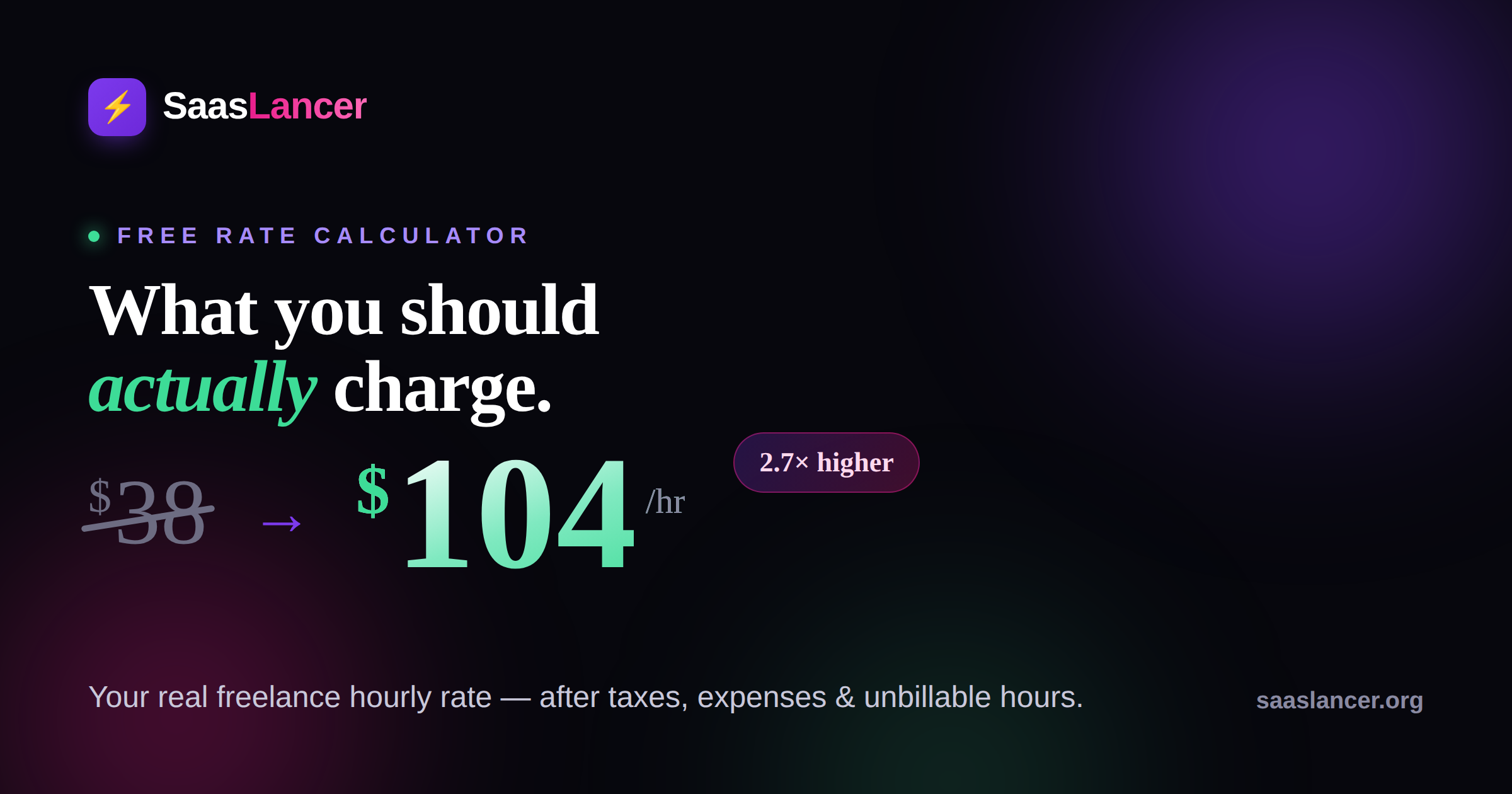
Say you want to take home $80,000. You work a normal-looking 40-hour week, so the quick mental math is $80,000 ÷ 2,080 hours, which lands at about $38 an hour. That feels reasonable. It is also wrong — and not by a little.
You do not actually bill 2,080 hours. Nobody does. Between pitching, scoping, invoicing, email, admin and the marketing that keeps the pipeline full, a big chunk of every week is unpaid. On top of that, taxes and business costs come straight off the top of whatever you invoice. The $38 figure silently assumes none of that exists.
What a “real” hourly rate actually means
Your real hourly rate is the amount you have to charge for each billable hour to still hit your take-home goal once unbillable time, expenses and taxes are stripped out. It is the floor you should never quote below — and it is usually two to three times higher than the naive “goal ÷ all hours” number.
Quick test: if the only math you’ve ever done is “salary I want ÷ hours I work,” your rate is built on the trap above. The fix isn’t to charge a random amount more — it’s to charge a number you can actually defend.
Four things your old employer quietly paid for
Going freelance means taking on every cost a job used to absorb on your behalf. Four of them do the most damage to your rate.
1. The hours you can’t bill
Most freelancers bill somewhere between 50% and 70% of the hours they actually work. The rest disappears into running the business. So a 40-hour week often produces closer to 24 invoiceable hours — and your rate has to make up the difference.
2. The full tax bill
As an employee, your employer quietly splits payroll taxes with you. On your own, you pay both halves. In the US, the self-employment tax alone runs 15.3% — the combined Social Security and Medicare bill that an employer would normally share — and that sits on top of income tax. The IRS spells out exactly how it works, and most countries have their own version. Whatever your jurisdiction, set the money aside before you count it as yours.
3. Every business expense
Software, hardware, insurance, a workspace, courses, accounting, platform fees — all of it now comes out of your revenue instead of a company budget. Freelancers routinely underestimate these by a third or more, which quietly drags the real rate down.
4. Unpaid time off
Every holiday, sick day and slow week is a week you simply don’t earn. There’s no paid leave waiting for you, so your billable weeks have to carry the whole year — including the ones you take off.
A real example, with the math
Take a freelancer who wants $80,000 in their pocket, spends $6,000 a year on business costs, sets aside 25% for tax, works 40 hours a week, takes 6 weeks off, and bills 60% of their time. Run that through honestly and the real rate lands around $104 an hour — not $38. Same person, same goal, same week. The only thing that changed is that the math finally told the truth.
That gap — roughly 2.7× — is the difference between a business that quietly compounds and one that stays busy while slowly going broke.
Skip the spreadsheet: the free Rate Calculator
You can absolutely work this out by hand, but it’s fiddly and easy to fudge in your own favour. So we built a free Rate Calculator that does it for you. Plug in your take-home goal, expenses, tax set-aside, hours and time off, and it shows your real hourly rate instantly — next to the naive number, so you can see exactly how big your own gap is.
It also hands you a suggested day rate, the total revenue you need to invoice for the year, a clean breakdown of where your hours go, and a copy-able rate card in six currencies. No sign-up, nothing stored on a server, and it runs entirely in your browser.
How to actually raise your rate
Knowing the number is half the battle. Acting on it is the other half. A few things that make it easier:
Quote new clients first
Your next proposal is the cheapest place to test a higher rate — there’s no relationship to renegotiate, just a number on a page. Start there and let the wins build your nerve.
Anchor to the outcome, not the hour
Clients don’t buy hours; they buy results. Frame your price around what the work is worth to them, and the hourly figure underneath stops feeling like the whole conversation.
Give existing clients fair notice
For people you already work with, a short, warm heads-up a few weeks out — “my rates are moving to X from next month” — lands far better than a surprise invoice. Most good clients expect it.
Stop apologising for the number
State your rate plainly and let it sit. The defensible floor you calculated isn’t greedy — it’s the price of doing this sustainably. Discounting on instinct just puts you back in the trap.
The bottom line
The rate in your head almost certainly forgot something — the unbilled hours, the taxes, the software, the weeks you don’t work. Find the real number, treat it as your floor, and price up from there with a straight face. It’s the single fastest way to make the same work pay what it should.
See your real hourly rate in 30 seconds
Free, private, no sign-up. Enter your numbers and find the rate you should never charge below.
Open the Rate Calculator →