
How Much of Your Income Should Come From One Client? The 20% Rule, Explained

That’s the rule of thumb most freelance-business advisors land on for how much of your income one client should provide. Below it, losing that client stings but doesn’t sink you.
Above 50% from one client, you’re not really running an independent freelance business anymore — you’re running an unofficial, unprotected job with one employer that can walk away without notice.
The harder part is actually knowing your own number, because most freelancers can guess which client pays the most but can’t say what percentage that really is until they sit down and add it up.
The risk
Why client concentration risk matters more than it feels like it does
When one client is paying most of your bills, everything about that relationship feels stable — until it isn’t. Contracts end. Budgets get cut mid-quarter. A new manager comes in and “restructures” the vendor list. None of that is really about your work quality; it’s just how businesses operate. The problem is that freelancers rarely see it coming, because the income has felt steady for so long.
This is the same idea finance teams use when they talk about customer concentration risk for small businesses — the more of your revenue that sits with one buyer, the more fragile your business is, even if this month’s numbers look great.
The number
How much of your income should come from one client, exactly?
There’s no single official percentage, but the working guidelines freelancers and small-business advisors tend to agree on look roughly like this. It’s worth knowing these thresholds shift depending on who’s asking — a business preparing for sale or a bank loan often gets held to a stricter bar (some valuation advisors flag concern starting around 15%), while the ranges below reflect the more common, everyday guidance for freelancers just keeping an eye on their own risk:
Healthy
Losing this client is annoying, not dangerous.
Watch it
Fine short-term, worth diversifying over time.
Concentrated
Start actively building a second or third client.
Dependent
One decision from this client can wipe out half your income.
Context matters, of course. A brand-new freelancer with one great retainer client isn’t in the same position as someone five years in who’s let one account quietly grow to 70% of their revenue. The first is normal; the second is a pattern worth breaking.
The quick formula
Say you billed $45,000 over the last five months, and $24,000 of that came from one client. That’s 53% — solidly in dependent territory, even if the work itself feels great.
Worth noting: concentration risk isn’t a reason to fire a good client. It’s a reason to make sure you’re not putting all your growth energy into just one relationship going forward.
The tool
The fastest way to check your own number
Most freelancers already have the data for this — it’s just scattered across invoices, bank deposits, and old spreadsheets that never quite get updated. Adding it up by hand once a quarter works, but it’s easy to put off, and by the time you do it, the picture might already be worse than you think.
We built the free Income Dashboard for exactly this. You log each payment against a client, month, and amount — either one at a time or pasted in from a spreadsheet — and it works out your concentration percentage automatically, shown as a simple gauge instead of a formula you have to remember.
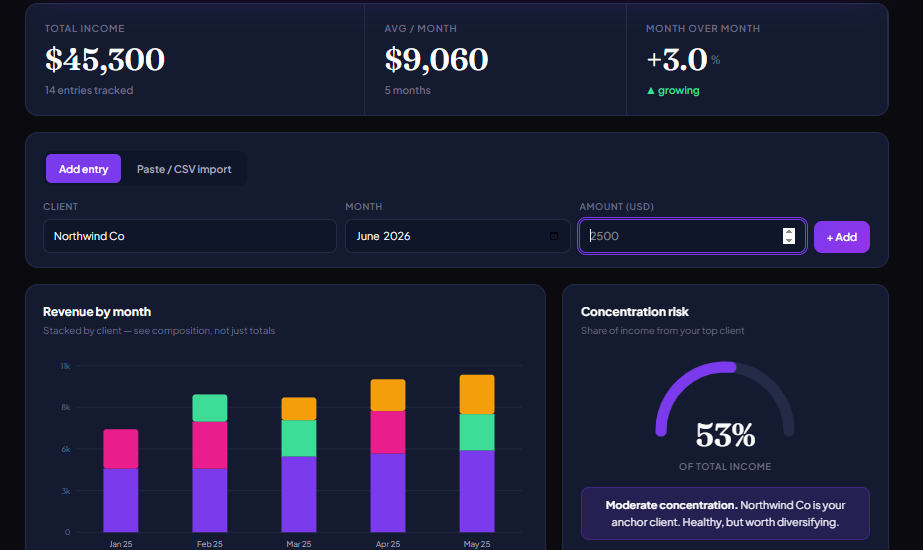
Nothing gets uploaded anywhere — the data stays in your browser, so it’s safe to plug in real client names without worrying about where that information ends up. If you want to see it working before entering your own numbers, the “Load sample data” button fills the whole dashboard in one click.
The fix
What to do if one client is carrying too much of your income
- Don’t cut ties abruptly. The client isn’t the problem — the imbalance is. Keep the relationship; just stop letting it be the only one.
- Set a soft cap for yourself. Something like “no new client work goes to less than three active accounts” keeps you from drifting back into the same pattern.
- Pitch smaller, part-time clients in parallel. They don’t need to replace your main income — they just need to exist, so a single cancellation doesn’t zero out your month.
- Recheck the number monthly, not yearly. Concentration creeps up slowly. A monthly glance at your Income Dashboard catches it while it’s still an easy fix.
- Keep a buffer. If one client really is unavoidable right now, a few months of expenses in savings does a lot of the same protective work while you diversify.
The spread
So how many clients should a freelancer have?
There’s no universal number, and chasing one for its own sake usually backfires — more clients means more overhead, more context-switching, and more admin per dollar earned. What matters isn’t the headcount, it’s the spread. Five clients at roughly 20% each is a healthier position than fifteen clients where one still quietly accounts for 60%.
A useful way to think about it: if every client sat at an even share of your income, you’d need five to ten regular clients to keep any single one comfortably under that 20% concentration mark. You don’t need to hit that number exactly — you just need to know whether you’re drifting away from it, which is the whole point of checking your concentration percentage regularly instead of going on gut feel.
Check your number in under a minute
Paste in your last few months of client payments and see your concentration risk instantly — free, private, and nothing to install.
FAQ
Frequently asked questions
What percentage of income from one client is too much?
Most freelance-business advisors treat anything above 30% from a single client as a risk worth actively managing, and anything above 50% as a serious dependency. Under 20% per client is generally considered a healthy, diversified spread.
Is it bad to have one client that pays most of my income?
It isn’t automatically bad, especially early on, but it does concentrate your risk. If that client cuts your hours, delays a renewal, or goes through a budget freeze, a large share of your income disappears at once. The tradeoff is worth making on purpose, not by accident.
How do I calculate client concentration risk?
Divide the income you’ve earned from your single biggest client by your total income over the same period, then multiply by 100. $15,000 from one client out of $45,000 total is a 33% concentration.
How can I track this without building a spreadsheet?
A free tool like SaasLancer’s Income Dashboard logs each payment against a client and month, then calculates the concentration percentage automatically as a gauge — no formulas required.
How many clients should a freelancer have to avoid concentration risk?
There’s no fixed number, but if each client sits near an even share of your income, five to ten regular clients keeps any single one under the 20% mark most advisors consider safe. Fewer clients isn’t automatically risky if the split is deliberate and monitored, not accidental.